Showing posts with label FORM 5 BIOLOGY. Show all posts

CHAPTER 5 INHERITANCE ( Part 3)

HUMAN KARYOTYPES
-In human, each somatic cell (body cell) has 46 chromosomes(2n=46) 
 but sex chromosomes( sperm and ovum) only has 23 
 choromosomes(n=23)
-Each somatic cell (diploid) has two sets of chromosomes. One set 
 of chromosomes comes from the father while the other set comes 
 from the mother.
-Both sets of chormosomes are paired up and known as homologous 
 chromosomes 


-autosome :chromosomes that do not have the genes to determine sex.All the chromosomes are autosomes except the sex chromosome
-sex chromosome: chromosome that has the gene to determine the sex of an organism


-Each human body cell has 23 pairs of chromosomes==>22 pairs of homologous autosomes and 1 pair of sex chromosome.
-FEMALE: 22 pairs of autosomes and one pair of X chromosomes  
 (44+XX)
-MALE: 22 pairs of autosomes, one X chromosome and one Y chromosome.


SEX DETERMINATION 
-The sex of the children is determined by the sex chromosomes of the parents.


The probability of getting a girl or a boy is 50:50


SEX LINKED INHERITANCE IN HUMAN
-There are certain characteristics are controlled by genes located on the sex chromosome,especially on the X chromosomes.
-In males,Y chromosome is smaller compare to X chromosome.
-Y chromosome carry so few genes                      
  e.g. genes for development of reproductive organs & male 
  characteristics


HAEMOPHILIA 


-a hereditary sex-linked disease that can be transmitted to the next generation
-Haemophiliac is lack of blood cotting factor,causing continuous bleeding after injuries. The blood clots very slowly.
-He or she maybe fatal due to excessive loss of blood.
-haemophilia is caused by the recessive allels( Xh) located on X chromosome. 


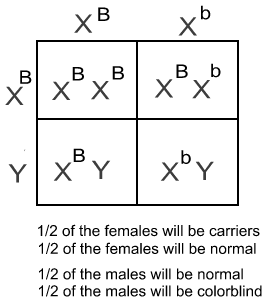
COLOUR BLINDNESS
-The person is unable to differentiate between the colours.
-The most common example is red-green colour blindness.
-Colour blindness is controlled by a recessive allele (Xb)


STRUCTURE OF DEOXYRIBONUCLEIC ACID(DNA)
-DNA is made up of monomers called nucleotides.
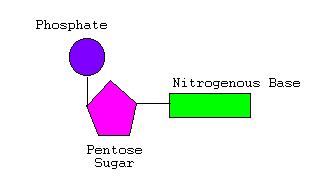


-there are 4 different types of bases:

  • adenine(A)
  • thymine(T)
  • cytosine(C)
  • guanine(G)
-each nucleotide is joined together to form polynucleotides.
-DNA is made up of two strands which twist around each other to form DNA double helix.
-The nitrogenous bases of two strands joined together by hydrogen bond.
-The bases are paired together based on complementary base pairing rule
  • A-T
  • C-G
                            
-phosphate group and deoxyribose sugar are the backbone of DNA


CHAPTER 5 INHERITANCE ( part 2)

DIHYBRID INHERITANCE
MENDEL'S SECOND LAW / LAW OF INDEPENDENT ASSORTMENT:
allele pairs separate independently during the formation of gametes. This means that traits are transmitted to offspring independently of one another.


-Dihybrid inheritance: The genetic cross between two parents involving two different characteristics.


e.g. a pea plant with round yellow seed  (RRYY) is crossed with a pea plant with wrinkled green seed (rryy


INHERITANCE OF ABO BLOOD GROUP
-is controlled by three alleles iA, iB and ii


-this is known as multiple allele where one gene is controlled 


 by more than 2 alleles.All alleles control the same


 characteristic.


-


- both alleles iA and iB are codominant whereas allele ii is

 recessive.


compatibility of blood group

-compatibility of blood group of a donor's blood and the recipient must be ensured in blood transfusion.
-Otherwise,coagulation of the red blood cells may occur.


INHERITANCE OF RHESUS FACTOR IN HUMAN
-Rheses factor (Rh factor) is an antigen on the membrane surface of 
 red blood cell.
-Rh+ ==> people with Rh factor
-Rh-  ==> people without Rh factor
-allele for Rh+ is dominant whereas allele for Rh- is recessive


-The presence or absence of Rh factor in the blood will not threaten a person's health.
-But,complications will arise during pregnancy if the mother's blood is Rh- and the foetal's blood is Rh+

  • Some of the foetal blood cells may enter the mother's blood via placenta.
  • This will trigger the mother's lymphocytes to produce anti-Rh antibodies to react with the Rhesus antigen in the foetal blood.
  • However,the first pregnancy does not usually cause any harmful effect to the foetus because the antibodies are not produced fast enough to enter the foetal's bloodstream before birth.
  • The anti-Rh antibodies will remain in the mother's bloodstream after delivering.
  • In the second pregnancy,the existing anti-Rh antibodies may enter the foetal bloodstream through the placenta. The antibodies may cause agglutination and haemolysis of the foetal red blood cells.
  • This condition is known as erythroblastosis fetalis
  • The foetus may suffer from severe anaemia,damage to the heart,liver and brain or may die.
  • Solution: A mother is given an intravenous injection of anti-Rh globulin after the first child is born to destroy and prevent the formation of anti-Rh antibodies in the next pregnancy.


Regards@ E-learning for SPM

CHAPTER 5 INHERITANCE ( part 1)

IMPORTANT TERMS
1. GENE
    basic unit of inheritance that determines a particular characteristic 
    in an organism
2. ALLELE
    Alternative form of a gene that occupies the same locus on the 
    same pair of homologous chromosomes
3. HOMOZYGOUS DOMINANT
    a pair of identical dominant alleles of the same trait 
4. HOMOZYGOUS RECESSIVE
    a pair of identical recessive alleles of the same trait
5. HETEROZYGOUS
    a pair of different alleles of the same gene
6. DOMINANT ALLELE
    allele which will express itself and mask the effect other another 
    recessive allele paired with it
7. RECESSIVE ALLELE
    allele which its effect will be masked by the dominant allele 
    paired with it
8. PHENOTYPE
    observable physical characteristics of an organism
9. GENOTYPE
    genetic content carried by an organism which determine its 
    phenotype and will be inherited to the next generation.  


GREGOR MENDEL


THE CHARACTERISTICS AND TRAITS OF PEA PLANTS STUDIED BY MENDEL
DOMINANT-RECCESIVE


CHARACTERISTICS OF PEA PLANTS USED
-short life cycle
-the characteristics are easily distinguished and observable
-easy to grow


MONOHYBRID INHERITANCE
MENDEL'S FIRST LAW / LAW OF SEGREGATION
: In the formation of gamete,each member of the gene pair segregates into a gamete, thus each gamete only receive one copy. 


-only one characteristic is used.
-Mendel chosen height of the pea plants as a characteristic
-he cross pollinated the selected pea plants by removing the anthers 
 from one flower, to prevent self-fertilization, and dusting pollen  
 from another plant onto the flower.
-pure breeds of tall and short plants are used as the parents.


-these initial plants are called the P (Parental) generation. The 
 resulting offspring, the F1 (Filial generation) were then self 
 pollinated to produce the F2 generation. This self-fertilization 
 continued until the traits were established for many generations.


v


FOR MORE REFERENCES =)
click on the links below:
 *Link 1
 *Link 2
 *Link 3


Regards@E-learning for SPM